
IndiGo will have 74 of its 224 weekly international departures affected while Air India will relocate 33 of its 100 departures.

'If you listen to a rowdy in a class, he will keep on bullying you.' 'India can say do whatever you want. We will not compromise on anything.'

'We are getting used to the constant alerts to take shelter, listening to sonic booms from jets flying above us, hearing news of neighbouring ports being targeted, and being the only ship in the terminal.'

The United States is facing growing discontent from its Gulf allies after several countries in the region complained that they were not given advance notice of the US-Israel strike on Iran that triggered widespread retaliatory attacks, according to media reports.

The US Central Command (CENTCOM) confirmed striking the Guinea-Bissau-flagged oil tanker MT Jalveer, carrying 20 Indian seafarers, in the Gulf of Oman for allegedly violating the US blockade against Iran. This incident marks the third commercial vessel attacked by US forces in the region this week, with three Indian seafarers previously losing their lives in an attack on the MT Settebello.

The UN Security Council, with India's support, has adopted a resolution condemning Iran's attacks on Gulf Cooperation Council countries and Jordan, demanding an immediate cessation of hostilities and denouncing threats to the Strait of Hormuz.

External Affairs Minister S Jaishankar lodged a strong protest with US Secretary of State Marco Rubio over US Navy attacks in the Gulf that killed three Indian mariners. India also summoned the US Charge d'Affaires in New Delhi regarding the incident.

The BRICS grouping adopted a consensus joint declaration in New Delhi, successfully navigating differences on the West Asia conflict but notably omitting any direct mention of US strikes on Iran or Iranian military attacks on Gulf Arab nations. The declaration also criticised Israel's actions in Gaza and called for a concerted approach against terrorism.

US President Donald Trump stated that the United States is taking a "low-key" approach towards Iran, focusing on economic pressure rather than military action, amidst ongoing tensions over the Strait of Hormuz. Trump highlighted Iran's worsening economic situation and the impact of the US naval blockade, while negotiations for reopening the Strait remain stalled due to new conditions from Tehran.

India has successfully evacuated 59 vessels, including 23 Indian-flagged and 36 foreign-flagged ships carrying cargo for India, from the Strait of Hormuz since March 1, 2026, amid fresh attacks and declining shipping traffic, Shipping Minister Sarbananda Sonowal informed the Rajya Sabha.
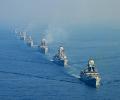
According to sources, the Indian Navy warships are on standby to provide assistance or help required by merchant vessels.

The Directorate General of Maritime Administration (DGMA) has instructed shipping companies to avoid deploying Indian sailors on vessels transiting the Strait of Hormuz due to the ongoing West Asia crisis, following recent attacks on two vessels carrying Indian seafarers.

Companies are already diversifying sourcing, raising prices, and reworking operating models as the disruption drags on.

28 Indian vessels carrying 778 seafarers are stranded in the Persian Gulf, prompting government monitoring and coordination to ensure their safety and security.

Egypt, Pakistan, Saudi Arabia and Turkey met in Islamabad in what analysts say is the formal opening of a new diplomatic formation that could reshape the post-war regional order. Their immediate goal is a ceasefire; their larger ambition is to ensure that neither Iran nor Israel emerges from this war in a dominant position. Pakistan's foreign minister then flew directly to Beijing and mooted a Chinese role as guarantor of any eventual agreement. Prem Panicker continues his must read daily blog on the Gulf War.

The United States has redirected 48 vessels in the Persian Gulf, particularly in the Strait of Hormuz, over the past 20 days amid ongoing enforcement actions related to restrictions on Iranian maritime assets by the US Navy.
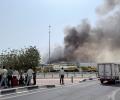
'In India, there is this first generation migrant, say from a small village in UP. He didn't go to the Gulf to buy a big house but make the life of his family better.' 'He may have paid 1 lakh rupees to an agent to go to the Gulf. Imagine what will happen to him and his family if he has to come back. He and his family will become poor again.' 'He went to the Gulf to come out of poverty, but this war will make his family trapped in poverty once again.'

Iranian Foreign Ministry spokesperson Esmail Baghaei stated that Iran is instead working with Oman to establish a mechanism for the safe passage of ships through the Strait.

Iran's Islamic Revolutionary Guard Corps (IRGC) Aerospace Force claimed to have fired several ballistic missiles at a US aircraft carrier and a destroyer, alleging the warships were harassing Iranian ships and participating in a naval blockade.

Iran has dismissed US President Donald Trump's assertion that Iran was responsible for a drone attack on Indian ships in the Strait of Hormuz as 'simply baseless'. The Iranian embassy stated that Trump's comments were an attempt to deflect attention from recent US military strikes on merchant vessels in the Gulf of Oman, which resulted in the deaths of three Indian mariners.

India has strongly protested a US military strike on the commercial vessel Settebello off the Oman coast, which left three of the 24 Indian crew members missing. The US Central Command stated it disabled the Palau-flagged vessel for violating a blockade of Iranian ports.

The captain of the Pakistani naval ship was overconfident, reckless and professionally incompetent. He displayed false bravado and by his actions would have caused grievous injuries to his men onboard and severely damaged the ship. On the other hand the captain of INS Kolkata maintained his cool, composure, displayed excellent seamanship skills and maintained his course and speed to avoid a major catastrophe. Comparison of the two captains shows the levels in professional competence of the two navies which are miles apart, points out Commodore Venugopal Menon (retd).

India has protected the interest of domestic farmers and MSMEs by not extending any duty concessions on products across several sectors, including agricultural items such as dairy, as well as chocolates, gold, silver, jewellery, footwear, and sports goods, under the trade pact with Oman.

Prime Minister Narendra Modi has highlighted the risks posed by the 'weaponisation' of resources and strategic sea routes, urging India to achieve greater self-reliance in energy to mitigate vulnerabilities to overseas supplies and geopolitical tensions.

Former US President Donald Trump has issued a stern warning to Iran, stating that "nothing will get through" unless a deal or "total surrender" is achieved, amid escalating tensions and conflicting reports on direct negotiations.
Next week's three-nation foreign tour of Prime Minister Narendra Modi will see India and Oman sign a free trade deal. The visit will also pave the way for agreements with Ethiopia and Jordan to increase India's bilateral trade and investments.

Trump further alleged that Iran was behind the attacks on three vessels carrying Indian seafarers near the Hormuz Strait, which resulted in the deaths of three, despite the US Central Command having confirmed that the strikes were carried out by American naval forces, calling the incident "totally unacceptable."

The broader conflict in West Asia, the largest international market for Indian carriers, has forced a sharp reduction in daily flights relative to the summer schedule.

The United States Central Command (CENTCOM) has confirmed the implementation of a naval blockade on Iranian ports, enforcing strict measures on vessels entering or departing, significantly escalating tensions between the two nations.

The question is no longer whether the war will expand. It has. The next few days will tell us whether the war stabilises around Hormuz or whether the Strait itself becomes the trigger for a far larger rupture. What to watch for over the next 48 hours is simple: Any move by the US toward direct naval control of the Strait; any credible Iranian attempt to disrupt or mine shipping lanes and, critically, whether energy infrastructure in the Gulf continues to be targeted.If those lines are crossed in tandem, the war will no longer be containable within the region.

Union Minister Pralhad Joshi assures that the Indian government is prepared to bring back Indians stranded in the Gulf region due to the Iran-Israel conflict and disruptions in Dubai, emphasizing citizen safety as the top priority.

The harsh truth is that the US is no longer a reliable partner, cautions Ramesh Menon.

India has summoned the US charge d'affaires for the second time this week to protest American Navy strikes on three commercial vessels off the coast of Oman, which resulted in the deaths of three Indian crew members. New Delhi has demanded an end to these attacks, acknowledging that the US Navy targeted the ships, some of which were reportedly non-compliant with US sanctions.

The US has warned India that any violation of its naval blockade in the Strait of Hormuz and illicit transport of Iranian oil will not be tolerated, a statement made amidst a diplomatic row over the deaths of Indian seafarers in US attacks on commercial vessels off the coast of Oman.

India has strongly protested to the United States after three merchant ships with Indian crew members were attacked by the American military off the coast of Oman, resulting in the deaths of three Indian nationals.

Two India-bound LPG tankers have crossed the Strait of Hormuz amid heightened tensions in the region, while an India-flagged vessel sank after being hit near the strategic shipping corridor.

Despite decades of efforts towards energy transition, oil will remain the critical energy source for all nations for some decades. We can hope for peace opening the Strait of Hormuz, but must prepare for war closing it, points out former foreign secretary Ranjan Mathai.

Specifically, military experts are assessing if the 'Octopus' interceptor anti-drone system, produced in the UK to support Ukraine in countering Russian threats, could be repurposed to strengthen British protections against Iran's Shahed drones.

India significantly increased its crude oil imports from Russia and the United Arab Emirates in June, securing supplies as the Strait of Hormuz began to reopen, with Russian barrels remaining attractive due to discounts and UAE supplies offsetting earlier uncertainties.

India on Friday launched a highly coordinated, priority operation to safely guide 13 Indian-flagged commercial vessels out of the volatile Strait of Hormuz, the ministry of ports, shipping, and waterways announced on Friday.
